Disclosure: Some links in this article are affiliate links. If you buy through them we may earn a small commission at no extra cost to you. It does not change what we recommend.
Office clothes are the hardest thing to buy cheaply, because the office is a fluorescent-lit room where people look at you from three feet away for eight hours. Everything a low price compromises — fabric weight, seam finish, how a shoulder sits — is visible under exactly those conditions.
Which is why the usual advice, “buy a cheap blazer and elevate it”, is precisely backwards.
Quick verdict
Buy soft structure, not hard structure. Knitwear, ponte, overshirts, wide-leg trousers in a fabric with weight, and shirting worn relaxed all read as professional and are within reach at fast-fashion prices. Tailored blazers, fitted shirting and anything requiring a crisp shoulder line are not, because they need fabric weight and internal construction that is not available at $25. Build the workwear capsule around the first list and buy the jacket somewhere else.
Why blazers are the trap
A blazer looks like the obvious office purchase and is the item most likely to disappoint.
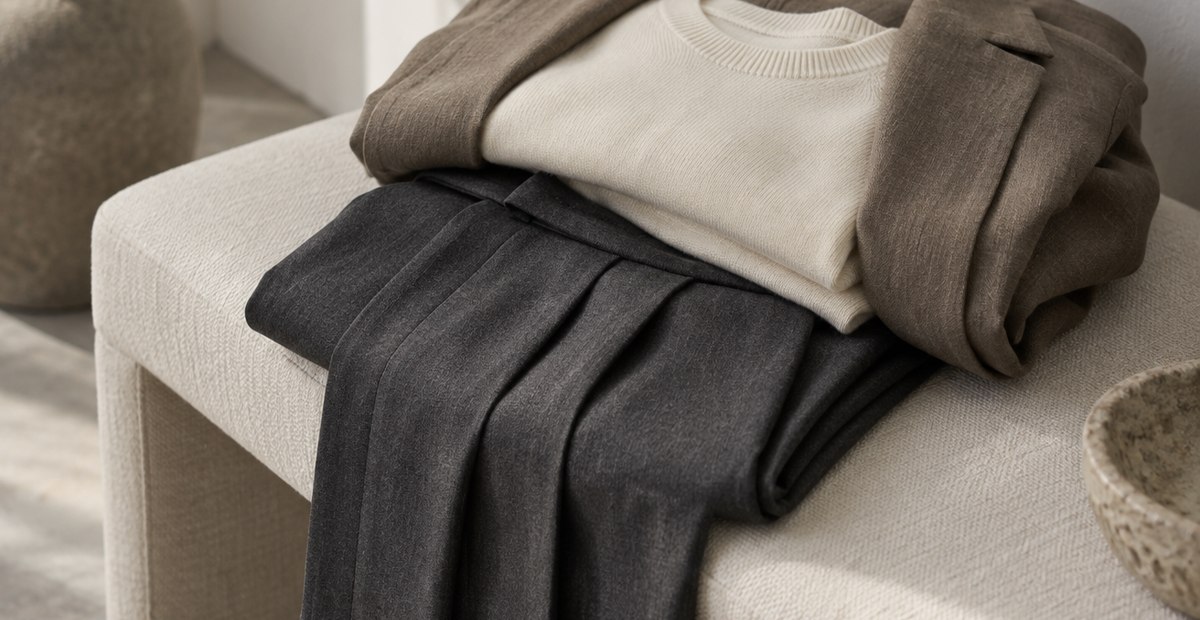
The shoulder line in a decent jacket is made by canvassing, padding and a fabric heavy enough to hold the shape. Below roughly 220 grams per square metre, none of that works: the collar rolls away from the neck, the shoulder slumps into the arm, and the lapel develops a wave after a fortnight of hanging on a chair.
The studio photograph will not show you this, because studio shots are taken on garments pinned at the back. The customer photographs will. If nobody in the review section has a shoulder line as clean as the model’s, the model’s was pinned.
So: if you need one good jacket, buy one good jacket and keep it for years. Spend the fast-fashion budget on everything it goes over.
What does work, in order of reliability
Fine-gauge knitwear. The most underrated office purchase available. A crew or mock-neck knit in a neutral does the job a shirt does, with none of the collar-and-placket risk. Look for acrylic blended with cotton or wool rather than pure acrylic, which pills where a coat rubs it.
Wide-leg and straight-leg trousers. The single highest-value item on the list, because they are worn constantly. Check the composition for a viscose or cotton blend with 2–3% elastane, and read the reviews specifically for “see-through” before anything else — thin trousers are the most common and most visible failure in cheap workwear.
Ponte and scuba-crepe dresses. Matte, weighty, forgiving on sizing variance, and they hold a column shape without needing construction. The most professional-looking thing on the site for the money.
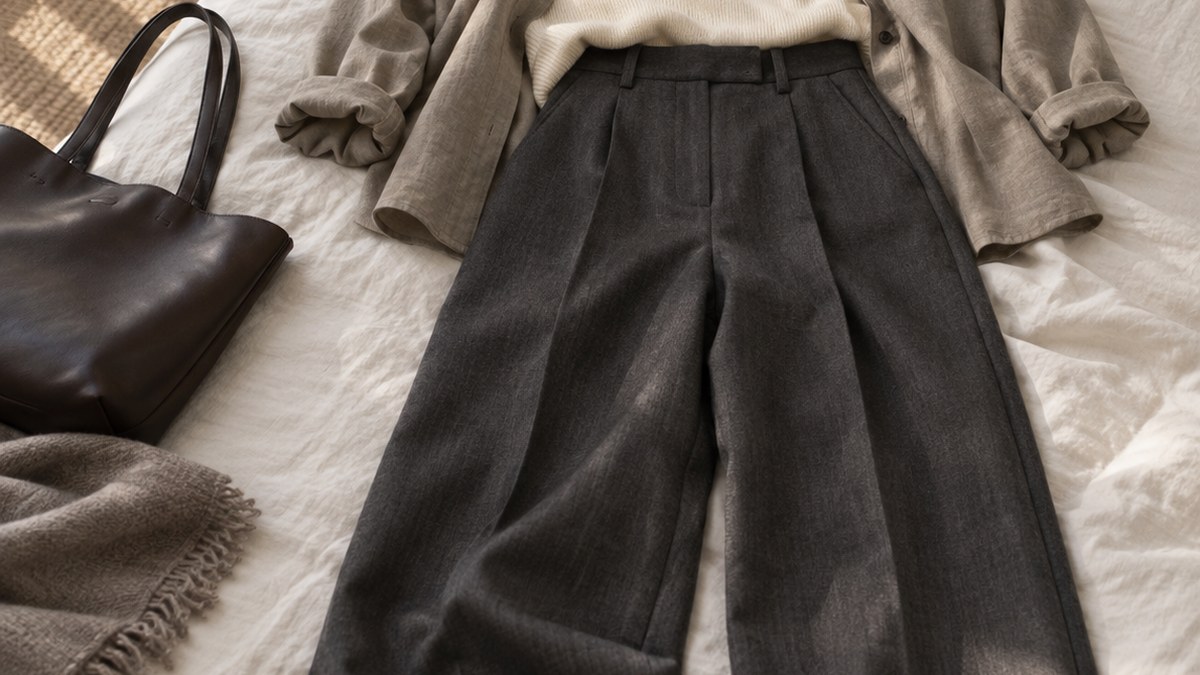
Overshirts and soft jackets. An unstructured overshirt does the layering job of a blazer while making no promises about a shoulder line. This is the honest substitution.
Relaxed shirting. Cotton or a cotton-rich blend, worn oversized rather than fitted. Fitted shirting exposes every shortcut in the collar, cuff and placket. Relaxed shirting does not.
The fabric rules for office lighting
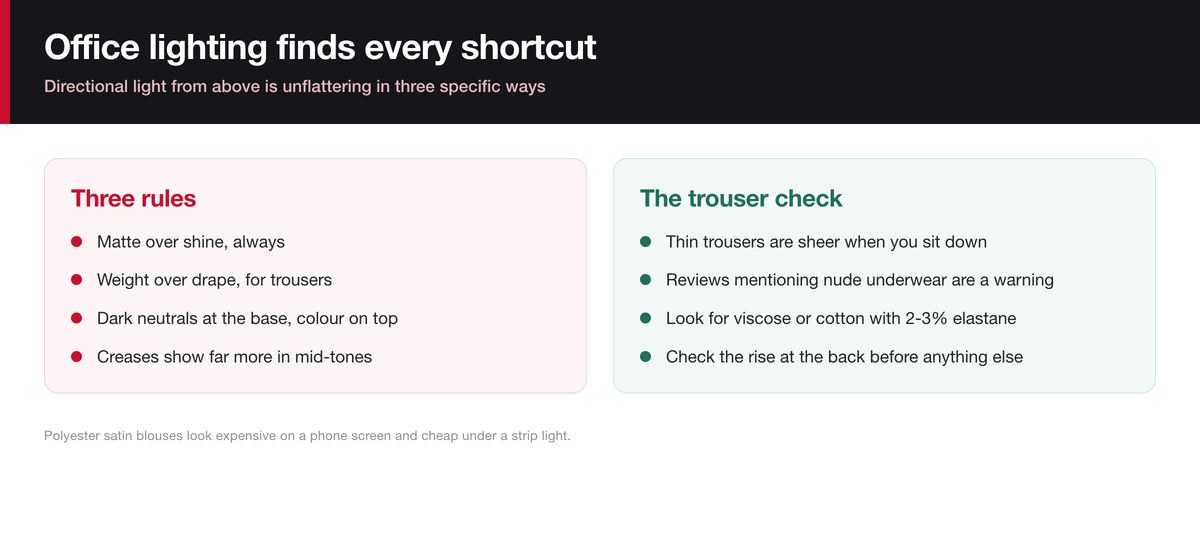
Overhead office lighting is unflattering in a specific way: it is directional, it is above you, and it finds sheerness and shine.
Three rules follow.
Matte over shine, always. Polyester satin blouses look expensive on a phone screen and cheap under a strip light. Crepe, ponte, jersey and matte woven fabrics do the opposite.
Weight over drape, for trousers. Thin trousers are see-through when you sit down, under light coming from above. This is the failure nobody tells you about and everyone notices. Reviews mentioning “had to wear nude underwear” are describing a garment to avoid.
Dark neutrals for the base, colour on top. Cheap fabric shows every crease, and creases are far more visible in mid-tones than in dark ones. Put the accent colour in the knit and the scarf, where it sits away from the body and is not being sat on all day.
A workable five-piece office core
- Black or navy wide-leg trousers, checked for opacity
- A second pair in a different neutral, because one pair is in the wash
- A fine-gauge knit in a neutral
- A ponte or crepe column dress
- An overshirt or unstructured jacket in the same palette as the trousers
That is five items covering a full working week, at a total cost that would not buy one mid-market blazer. Add a relaxed shirt and a second knit in an accent colour and you have a fortnight without repeating an outfit.
The structural piece — a coat, or a jacket if your office needs one — comes from somewhere else and lasts years. That split is the whole strategy.
Fit checks that matter in an office
Different from party dressing, because you will be sitting, typing and reaching for eight hours.
Sit down in the trousers and check the rise at the back. Cheap trousers tend to be cut with a short rise, which is invisible standing up and obvious in a meeting.
Raise both arms in the knit. Fine-gauge knitwear at this price is frequently cut with a tight armhole, which pulls the whole body of the garment up when you reach for something.
And check the hem length against the shoes you wear to work, not against the shoes in your wardrobe. Wide-leg trousers are cut long, and the difference between a flat and a low heel is the difference between a hem that skims the floor and one that drags along it.
Because SHEIN sizing runs small against US sizing and varies between suppliers, ordering two sizes of the trousers in a single order is the sensible move — the first return from an order is free and covers both.
What to skip entirely
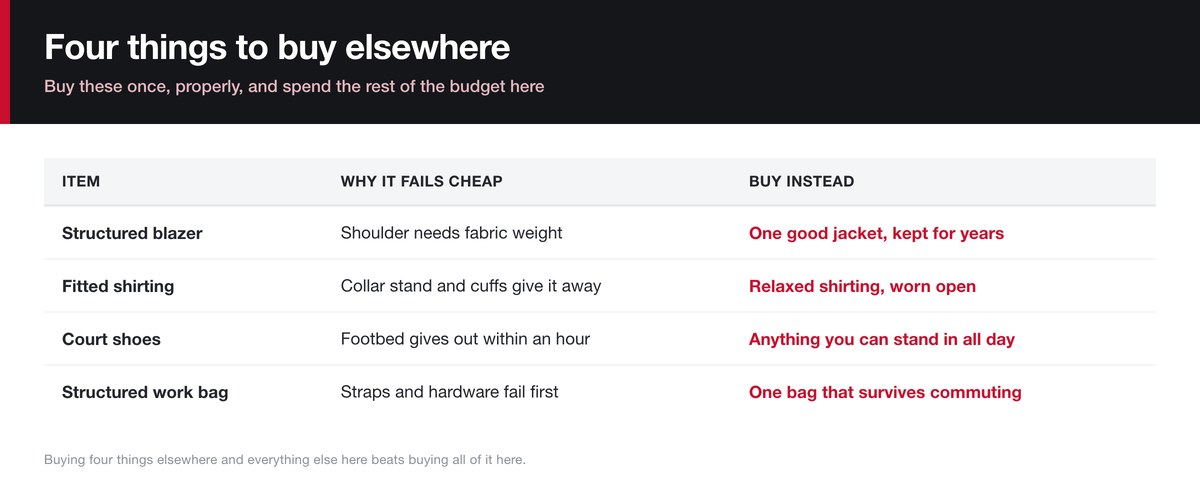
Structured blazers, for all the reasons above. Fitted shirting, where the collar stand and cuffs give the price away at close range. Court shoes, which are the weakest category on the site — the uppers photograph well and the footbed is unpleasant after an hour, which matters a great deal in an office. Structured work bags, for the same reason: a bag is a hardware product, and hardware is where low-cost construction fails first.
Buying those four things elsewhere and everything else here is a considerably better use of the same money than buying all of it here.
The fibre-by-fibre detail behind these calls is in our fabric composition guide, and the palette logic is in the capsule wardrobe piece.
Notes and sources: SHEIN product listings, composition fields and US return policy, checked September 2026. Fabric weights are rarely published on fast-fashion listings; the guidance above is based on the construction thresholds at which tailored garments hold their shape, and on customer photography as a proxy. Compositions differ between suppliers, so the individual product page is the authority.
