Disclosure: Some links in this article are affiliate links. If you buy through them we may earn a small commission at no extra cost to you. It does not change what we recommend.
There is a line on every SHEIN listing that predicts, with reasonable accuracy, whether you will still be wearing the thing in a year. It is not the price, the rating or the number of people who bought it this week. It is the composition.
Most shoppers never open it, which is why most hauls have the hit rate they do.
Quick verdict
Fibre content is the most reliable quality signal available on a fast-fashion listing, and it is published on every one. The headline “material” field is descriptive marketing — “linen look”, “silky”, “soft touch” — while the composition line inside the product details gives actual percentages. Learn to read five or six fibres and you can filter a catalogue of millions down to the things worth your money in about fifteen seconds an item.
Where to find it, and what you are looking at
On a product page, scroll past the size selector into the product details panel. You are looking for a line with percentages in it — “95% polyester, 5% elastane” — not the field that says something evocative.
Three warning signs, in order of seriousness:
- No composition given at all. Close the tab. On a site this large, there is another version of the same garment that does list it.
- Vague composition. “Poly blend” without percentages usually means a high synthetic content that the listing would rather not specify.
- Composition contradicting the description. A dress described as linen with no flax in the composition is a texture reference, not a fabric. This is extremely common and entirely legal, and it is why reading the percentages matters.
The six fibres worth knowing
Cotton. Breathable, gets softer, takes a hot wash badly in the first cycle. Best in tees, shirting, joggers and anything worn against skin. On SHEIN it mostly turns up in basics and is often blended down with polyester — anything above about 60% cotton is a reasonable buy. Expect some shrinkage on the first wash and buy accordingly.
Polyester. The default fibre of the entire category, and not inherently bad. It is the correct choice for activewear, swimwear and outerwear shells, where you want stretch recovery and water resistance. It is the wrong choice for anything meant to look expensive: it takes light with a shine, holds heat, holds odour, and reads as cheap in exactly the garments where you would notice.
Viscose and rayon. Beautiful drape, lovely hand feel, and the shortest useful life of anything on this list. It creases if you look at it, loses shape at the seat and knee, and can shrink unpredictably. Buy it for a drapey summer dress you will wear a dozen times. Do not buy it for trousers.
Elastane / spandex. Only ever a few per cent, and those few per cent do a lot. Two to five per cent in a woven gives you comfort without sag. Above about eight per cent in a non-activewear garment usually means the fit has been solved with stretch rather than with pattern cutting, and it will bag out at the elbows and knees.
Acrylic. The standard knitwear fibre at this price. Warm, light, cheap, and pills. An acrylic-cotton or acrylic-wool blend at a decent gauge is genuinely good value; 100% acrylic in a fine gauge will look tired after a month of wear against a coat.
Wool and linen. Rare here and worth noticing when they appear. Even a 20% wool content in a jumper changes how it holds shape and how warm it is.
Match the fibre to the garment, not to a hierarchy
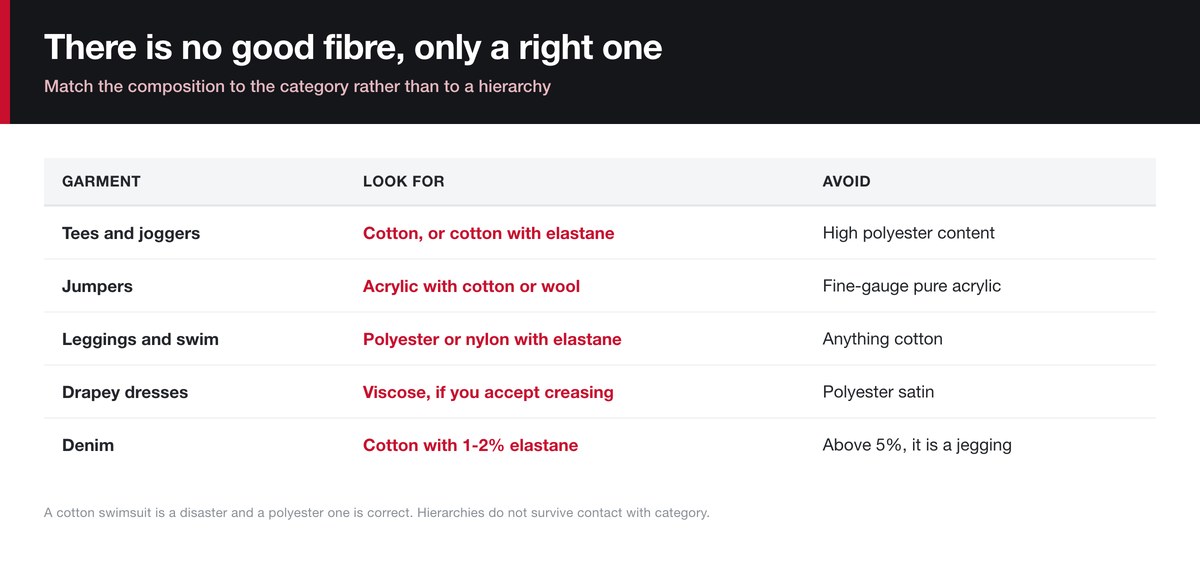
The mistake people make once they learn this is treating natural fibres as automatically superior. They are not. A cotton swimsuit is a disaster and a polyester one is correct.
Roughly:
- Tees, shirts, joggers, underwear: cotton, or cotton with a little elastane
- Jumpers and cardigans: acrylic blends, ideally with cotton or wool in the mix
- Leggings, sports tops, swim: polyester or nylon with elastane — this is the right answer, not a compromise
- Drapey dresses and blouses: viscose if you accept the creasing; avoid polyester satin unless you like shine
- Denim: cotton with 1–2% elastane for comfort stretch; anything higher is a jegging
- Blazers and coats: honestly, look elsewhere. Structure needs fabric weight that is not available at this price point
Weight matters as much as fibre, and nobody publishes it
Two garments can share a composition and behave completely differently because one is twice as heavy. Fabric weight — grams per square metre — is what makes a blazer hold a shoulder or a t-shirt hang rather than cling.
Fast-fashion listings almost never publish it, so you are reading proxies:
Customer photographs taken indoors will show you whether a light top is see-through. Reviews mentioning “thin”, “flimsy” or “had to wear something underneath” are describing low gsm. On knitwear, look for the word “chunky” and check whether the customer photos show stitch definition or a flat, fuzzy surface. And on anything structured, if the studio photo shows a shoulder line that looks crisp but no customer photo reproduces it, the garment is pinned.
The smell test, and when to send it back
A new garment with a strong chemical smell is worth taking seriously rather than airing out on a radiator.
Independent testing of goods bought from cross-border platforms has repeatedly found chemical limit breaches in particular categories. Seoul’s city government ran multiple rounds of laboratory testing across 2024 and reported harmful substances in a substantial share of the children’s products it checked, with individual footwear results far above permitted phthalate levels. Greenpeace testing of apparel samples found a minority exceeding EU chemical limits. SHEIN says it runs risk-based third-party testing and requires supplier compliance with the law in each market it sells into.
The proportionate response is category discipline rather than avoidance. Wash new clothes before wearing them. Be more careful with infant and toddler items, faux leather worn against skin, and soft PVC. And if a strong solvent smell survives two washes, that is a return, not a quirk.
Fifteen seconds per listing
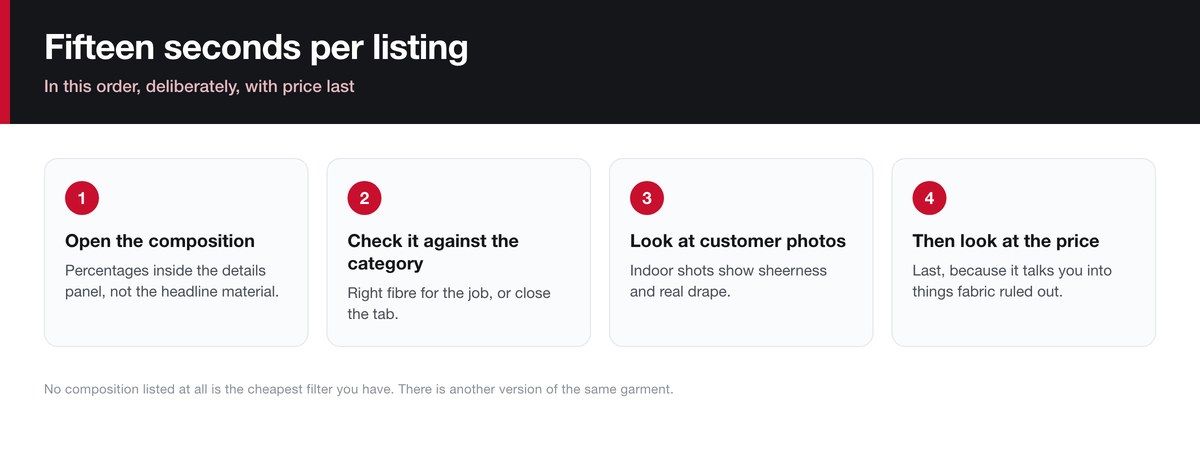
Open the composition. Check the percentages against the category. Scroll to the customer photos and look for sheerness and shape. Search the reviews for the failure word. Then look at the price.
In that order, deliberately. Price last is the whole point — it is the number most likely to talk you into something the fabric has already ruled out.
Notes and sources: SHEIN product listings and composition fields, checked September 2026; Seoul Metropolitan Government product safety testing rounds, 2024; Greenpeace chemical testing of fast-fashion apparel; SHEIN published statements on supplier testing and compliance. Listings rotate constantly and compositions differ between suppliers, so the detail panel on the individual item is the authority.
