Disclosure: Some links in this article are affiliate links. If you buy through them we may earn a small commission at no extra cost to you. It does not change what we recommend.
Everyone who has ordered a large SHEIN haul knows the specific feeling of unpacking it. Twelve items arrive. Four are good. Three are wrong in a way you suspected when you clicked. Two are fine but you already own something nearly identical. And three are the ones you bought because the basket was nearly at the free shipping threshold.
That last category is the expensive one, and it is entirely avoidable.
Quick verdict
A haul works when you shop from a list of gaps rather than a feed of possibilities. The mechanics reward bulk ordering — free shipping above a threshold, one free return per order — so the platform is built to make you add just one more thing. Decide what you need before you open the app, buy two sizes of anything fitted, and treat the haul as a fitting session rather than a delivery.
Start from the gaps, not the feed
The single behavioural change that improves hit rate is doing ten minutes of work before you open the app.
Go and look at what you actually wore in the last three weeks. Not the whole wardrobe — the pile on the chair, the things in the wash, the items you reach for. That is your real wardrobe. Everything else is storage.
Then write down the gaps, specifically. Not “tops”. Something like: a long-sleeve layer in a colour that works under the grey coat; a second pair of black trousers because the good ones are in the wash twice a week; one dress that survives a wedding without needing new shoes.
Three to six lines. That list is your basket. Anything that gets added later needs to displace something on it, not sit alongside.
The thresholds that are quietly shaping your basket
It is worth understanding what the site is doing, because the incentives are not hidden, they are just easy to fall into.
Standard shipping is free above $29 in the US, and above $15 on Sundays and Thursdays. That day-of-week rule is real money and almost nobody plans around it — a $20 basket that costs $3.99 to ship on Monday ships free on Thursday. First orders above $15 also ship free.
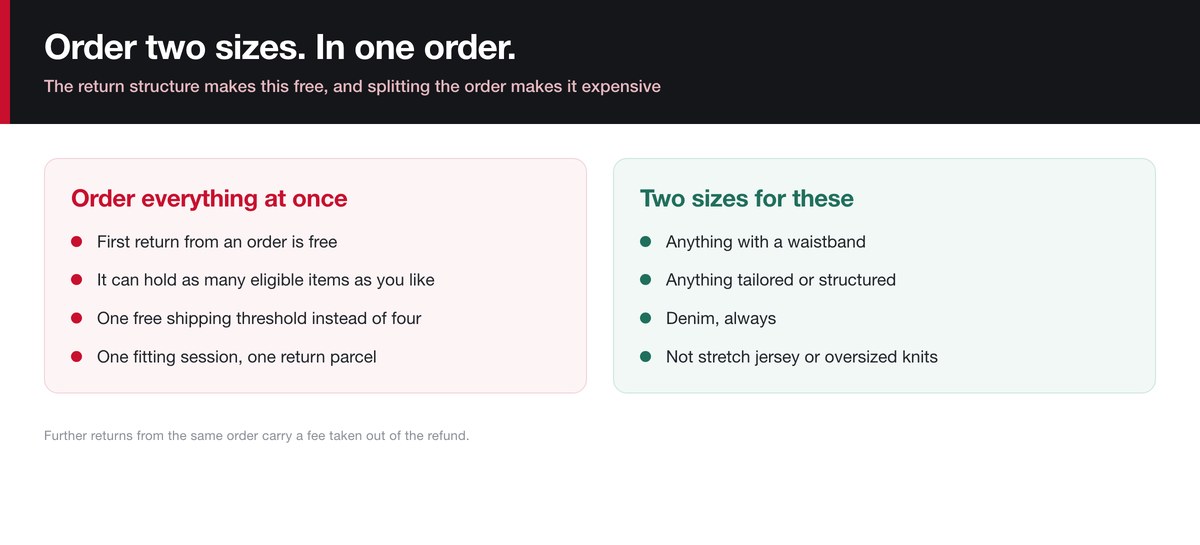
The return structure matters more. The first return from an order is free and can contain as many eligible items as you like. Additional returns from the same order carry a fee taken from your refund. Two consequences follow, and they are the whole strategy:
- Order everything at once. A single order with eight items has one free return. Four orders of two items have four separate return clocks and three fees waiting to happen.
- Try it all on in one session, then send back one parcel. Do not return things as you get round to them.
Buy two sizes of anything fitted
This feels wasteful and is the opposite. SHEIN sizing runs small against US sizing and varies between suppliers, because different factories produce different listings. A size you own is not a size you can assume.
Since the first return from an order is free regardless of how many items are in it, ordering two sizes of a fitted piece costs you nothing but the time to send one back. Do it for anything with a waistband, anything tailored, and anything you genuinely want to keep.
Do not do it for stretch jersey, knitwear or anything oversized by design. Those are forgiving enough that the measurement chart will get you there.
And read the chart for the specific item. SHEIN publishes body measurements and product measurements on each listing, and for structured pieces the product measurements compared against a garment you already own are far more reliable than any size letter.
The composition line does more work than the price
If you take one filtering habit from this article, make it this one.
Every listing has a headline material description, which is marketing, and a composition line inside the product details, which has percentages. Read the second one. A $12 top in cotton will outlast a $16 one in polyester, and the polyester one photographs better under studio lighting, which is why it is $16.
Rough guidance that holds across the catalogue: cotton, wool and linen wear best and turn up mostly in basics. Polyester is correct for activewear and swim and wrong for anything meant to look like silk. Viscose drapes beautifully and creases immediately. And a listing with no composition line, or one that contradicts the description — a “linen” dress with no flax in it — is telling you something.
Read the customer photos, skip the studio shots
Studio images on any fast-fashion site are lit, clipped and often shot on a garment pinned at the back. The customer photo section is the useful part: bad lighting, real bodies, and a fair sample of what turns up in the bag.
Two habits inside that section. Filter for reviewers near your own measurements if the site offers it. And search the review text for the failure word for that category — “sheer” for light tops, “pilling” for knits, “scratchy” for anything wool-adjacent, “gaping” for denim.
Also weight the review count, not the score. A 4.9 from 38 reviews tells you almost nothing. A 4.4 from 4,000 tells you quite a lot.
The things worth buying, and the things that never work
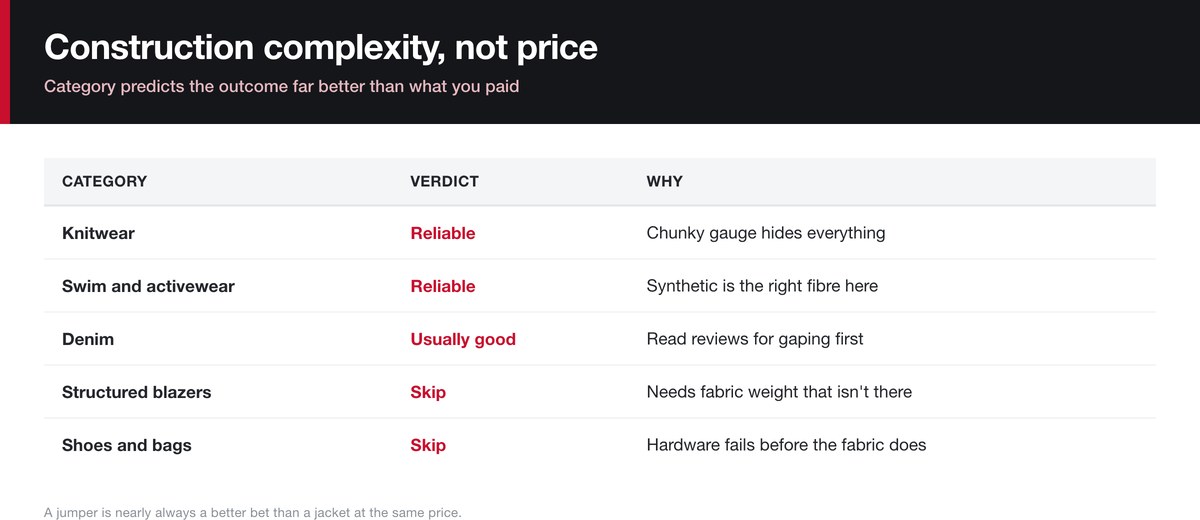
After enough hauls a pattern emerges, and it is about construction complexity rather than price point.
Reliable: knitwear and jumpers, where a chunky gauge hides everything. Swimwear, where high-stretch synthetic is the correct fabric rather than a compromise. Activewear, which competes with brands charging four times as much. Simple jersey layering pieces. Denim, when the reviews are good and there are hundreds of customer photos.
Rarely worth it: shoes, which look right in photographs and have a footbed that gives out within an hour. Bags, which are hardware products pretending to be fashion. Structured blazers and coats, because holding a shoulder line requires fabric weight that is not there at this price. Anything where the detail is a collar, a placket or a visible zip — cheap construction shows up in the hardware first.
A jumper is nearly always a better bet than a jacket at the same price. That one heuristic will save you more than any discount code.
Ignore the struck-through price entirely
This is not scepticism, it is a documented finding. France’s competition and fraud authority fined SHEIN 40 million euros in 2025 over misleading discount claims, after examining a large sample of its promotions and finding non-compliance across the majority — including a slice where the “reduced” price was in fact an increase.
You do not need to make that a moral issue to make it a useful one. It means the reference price on a listing carries essentially no information. So the only question that matters is whether the item is worth what it costs today. If it isn’t, a bigger red number does not change the answer, and the countdown timer is interface decoration.
A haul routine that works
- Write the gap list before opening the app. Three to six lines, specific.
- Build the basket from the list. Add two sizes for anything fitted.
- Check each item’s composition line and customer photos before it goes in.
- Order on a Sunday or Thursday if the basket is small, to catch the lower free shipping threshold.
- When it lands, try everything on in one session, with the shoes and the coat you would actually wear it with.
- Send back one parcel, inside the window. Keep the free first return for the whole lot.
- Confirm delivery in the app afterwards, which is how the points actually accrue.
None of that depends on a code, a sale event or a promotion, which is exactly why it keeps working.
Notes and sources: SHEIN US shipping thresholds and return policy, checked September 2026; DGCCRF enforcement findings and the 40 million euro fine over misleading discount displays, reported 2025. Thresholds, fees and return windows vary by market and change without notice — the terms shown at your own checkout are the ones that apply.
